Designing an identity for LinkedIn Hiring Assistant
How an identity system built for LinkedIn’s first AI agent evolved across 2 years of development and a conversational pivot — becoming the model for future teams to build against.
- I owned Hiring Assistant’s identity from inception — the personification framework and point-of-view model that scaled across multiple modalities, teams, and phases of development.
- I designed the header pattern that made the agent feel agentic before any conversational UI existed, and one that mapped directly onto incremental iterations as the technology behind it evolved.
- The identity framework held through a late-stage pivot to a chat-first modality. This validated early decisions made re: agent identity, input affordances, and established mental models for agentic workflows.
- Hiring Assistant landed as intended with the talent industry. Customers and analysts received it as a true hiring partner, not just an AI feature or a replacement for the human aspects of the work.
$450M
Annualized revenue run-rate
Agentic Talent Solutions — Microsoft FY26 Q3 earnings
62%
Fewer profiles reviewed per qualified match
When working with Hiring Assistant
69%
Higher InMail acceptance rates
Compared to traditional sourcing methods
Overview
LinkedIn launched Hiring Assistant to general availability in 2025 as its first enterprise AI agent. This was an evolution of Recruiter’s existing AI-assisted features into a truly agentic partner that works alongside users’ complex hiring workflows.
The challenge
We needed to align on and establish an identity for Hiring Assistant — one that would accurately set expectations for the product in a world where agentic tech was still novel. And since the first release wouldn’t include a chat UI, we’d need to establish an agentic affordance through static identity, response frameworks, and architectural patterns.
My role
I led design work for Hiring Assistant’s identity system: its personification, point of view, and interaction patterns within conversational modalities and the broader Recruiter experience. This work evolved alongside the team and product from early 2024 through 2026.
A shift in identity
Hiring Assistant was a natural evolution of Recruiter’s suite of existing AI-assisted features. These operated across search, content, and outreach, and they were each designed with deliberately impersonal identities: no names, no first-person references, just system-based components.
And while this decision made sense for those features, Hiring Assistant was different. It was designed to be an autonomous partner, one that would work across workflows, take direction from users, and report back on its work. This autonomy meant that it would need to have a clear, consistent identity for users to engage with. And one that would allow it to accurately report on its work.
This is where my work began. During the discovery sprint for Hiring Assistant, I led the team through a lightning talk session that explored the ways Hiring Assistant would need to diverge — and move beyond — our existing identity practices. It needed to become someone that users would work with across their hiring workflows.
Introducing a higher level of personification
The main shift revolved around personification: a feature’s ability to demonstrate human-like characteristics, behaviors, or communication styles. Given the ways Hiring Assistant would need to work, we needed to build in a higher level of personification.
Not personified
LinkedIn Recruiter“30 candidates are ready for review.”
- No name, identity, or self-reference
- Uses system voice and components
- Speaks about a product or feature
- Uses third-person perspective
- Speaks to users in second-person
Personified
SelectedHiring Assistant“I found 30 candidates — ready to review when you are.”
- A name, identity, and ability to self-reference
- Can speak in first, second, and third person
- Speaks as the product or feature
- Still leverages established brand voice and guidelines
Highly personified
Scout — your hiring assistant“Howdy! I dug through 30 candidate profiles and found some real gems.”
- A name, identity, and personality
- Builds on top of established brand attributes and voice as a distinct character
- Personality is an intended part of the product
- Still leverages established brand voice and guidelines

Personification ≠ personality
This didn’t mean creating a character for Hiring Assistant though. We’d still leverage the core voice and tone built into LinkedIn’s brand guidelines — the difference would be in how it interacts with users.
The direction landed with the sprint team and set intentions early for how we’d handle this new paradigm of agentic identity across Recruiter. A few things in particular resonated with leadership:
- Personification meant a clear graduation path for when we added chat to the product
- Rooting the identity in LinkedIn’s brand — just personified — allowed for flexibility during a time when the company was working through parallel brand-based decisions.
Headers as an agentic affordance
Hiring Assistant’s charter release was anchored in a full-screen intake experience — the surface where recruiters gave the agent its first direction on the role, the candidates, and how outreach should feel. It was the first moment where users would meet and interact with Hiring Assistant. And without a chat experience baked into the charter release, the page structure itself needed to carry the weight of making the experience feel “agentic.”
We learned pretty quickly that this wasn’t a simple task. Agents were still novel tech at the time, and our team lacked a shared, solid reference for what made something truly feel agentic in a non-conversational UI. As a result, we spent the early months shifting between two approaches:
- Having Hiring Assistant speak directly to users through the page headers + content in a full-screen experience
- Using Recruiter’s system-level content to introduce Hiring Assistant + task context — within the Recruiter shell
Both approaches were defensible, and each one had real implications for how we’d build out the rest of the charter experience.
I took the lead on stress-testing these directions with the goal of aligning our group on a single, preferred direction. This involved mapping each approach across the entire intake flow — and exploring each with varying levels of Hiring Assistant’s visual indicators: gradients, colors, and iconography.
Establishing the agent
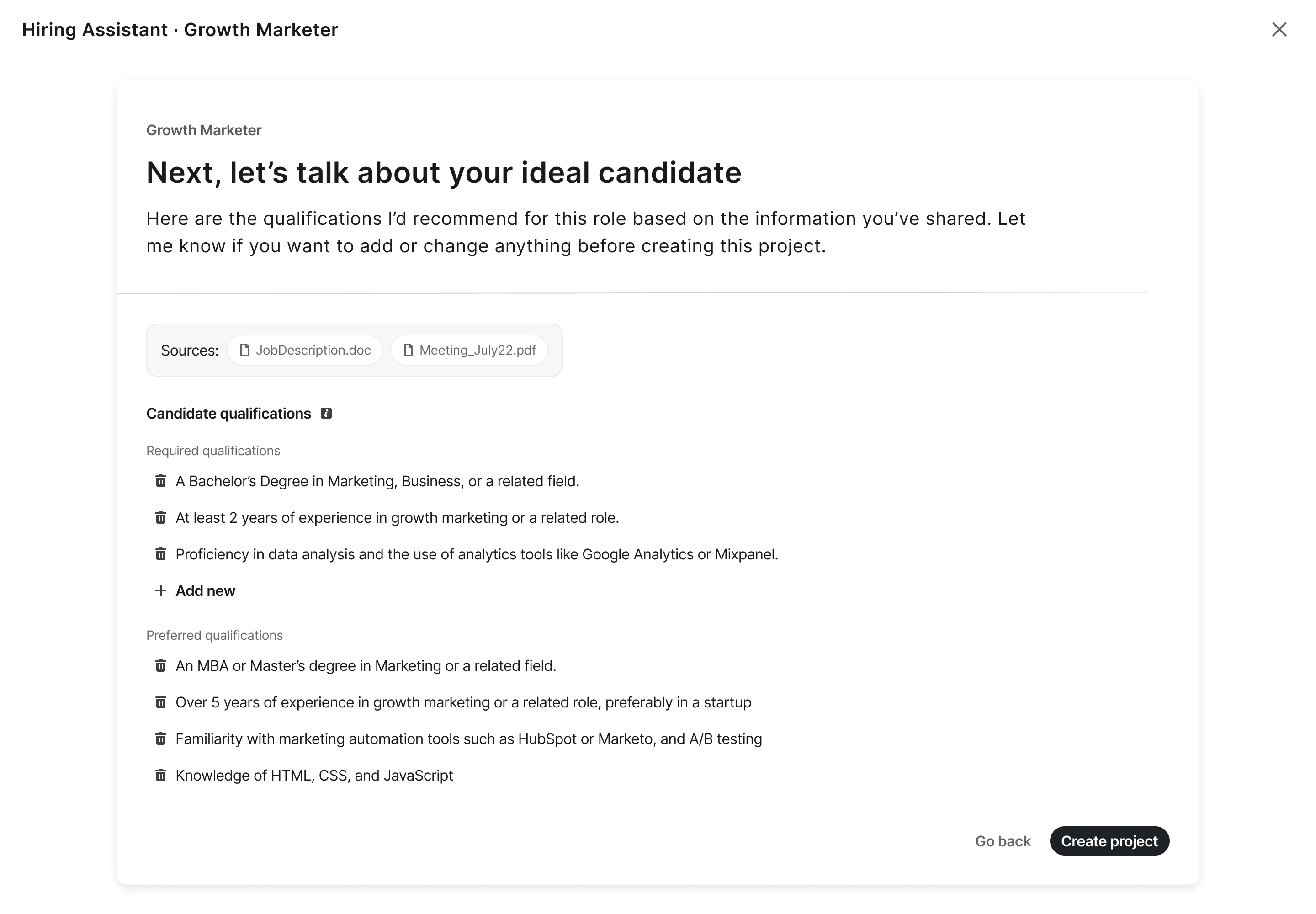
The first approach brought Hiring Assistant's identity into the full header section — something that the full-screen approach made feasible contextually.
The tension: This prioritized agentic identity at the risk of losing the Recruiter context.
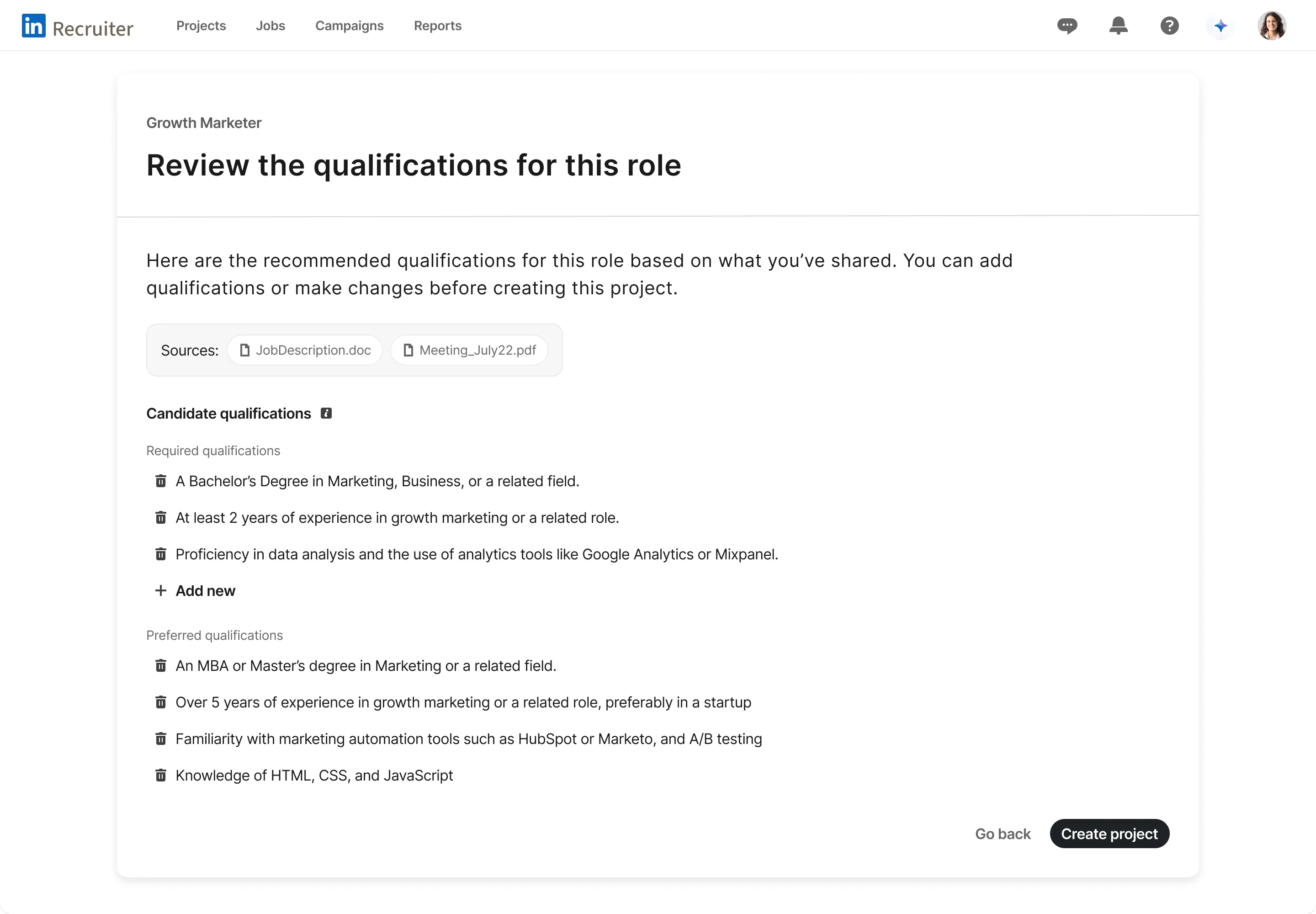
Framing the Recruiter context
The other approach pared back the identity and personification elements in favor of a simplified, more functional recruiter context.
The tension: This indexed on usability at the expense of setting agentic expectations, something that had a real cost in UXR. It also split the header content into two separate frames.
Leaning into the experience
My first exploration leaned into the full-screen approach and proposed a new header section focused fully on Hiring Assistant — leveraging personification and more elements of its visual identity.
Paring back the personification
This exploration aimed to blend the updated header section into the existing Recruiter shell and components. The main intent was reinforcing agentic presence without needing to lean into mixed personification or POVs.
Bringing back familiar patterns
We also looked at a version that split the header section back into a more traditional and familiar pattern — something that mapped more directly to other screens + flows that are framed in the Recruiter shell.
Aligning on the winner
This was the winning approach, and it leaned even further into the full-screen affordance. It leveraged the updated header, personification, and a more saturated use of visual identity cues.
Why it worked: Leaning into the full-screen experience made this feel more unique and distinct. This resonated internally and was the first step toward establishing a shared sense of “agenticness.”
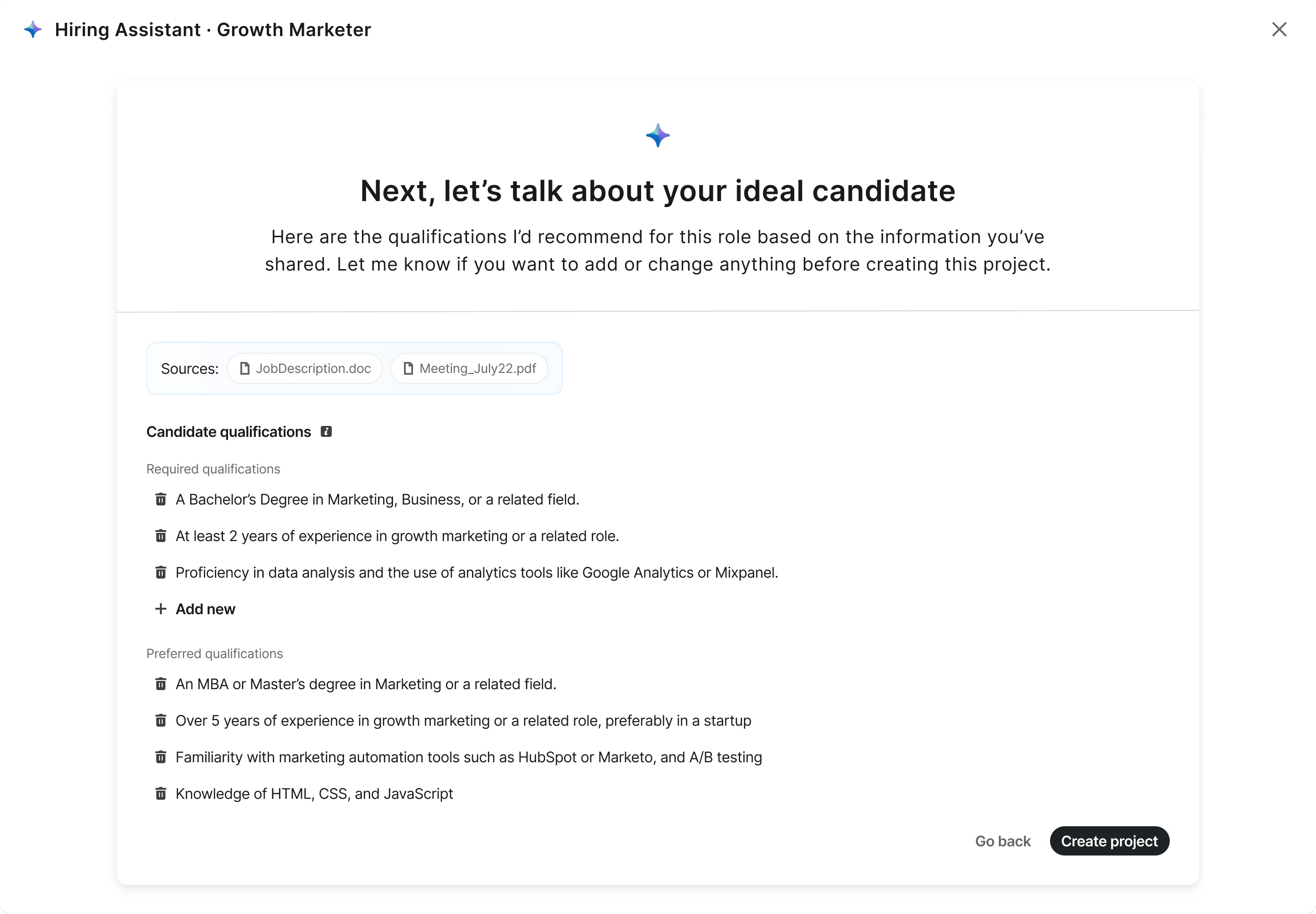
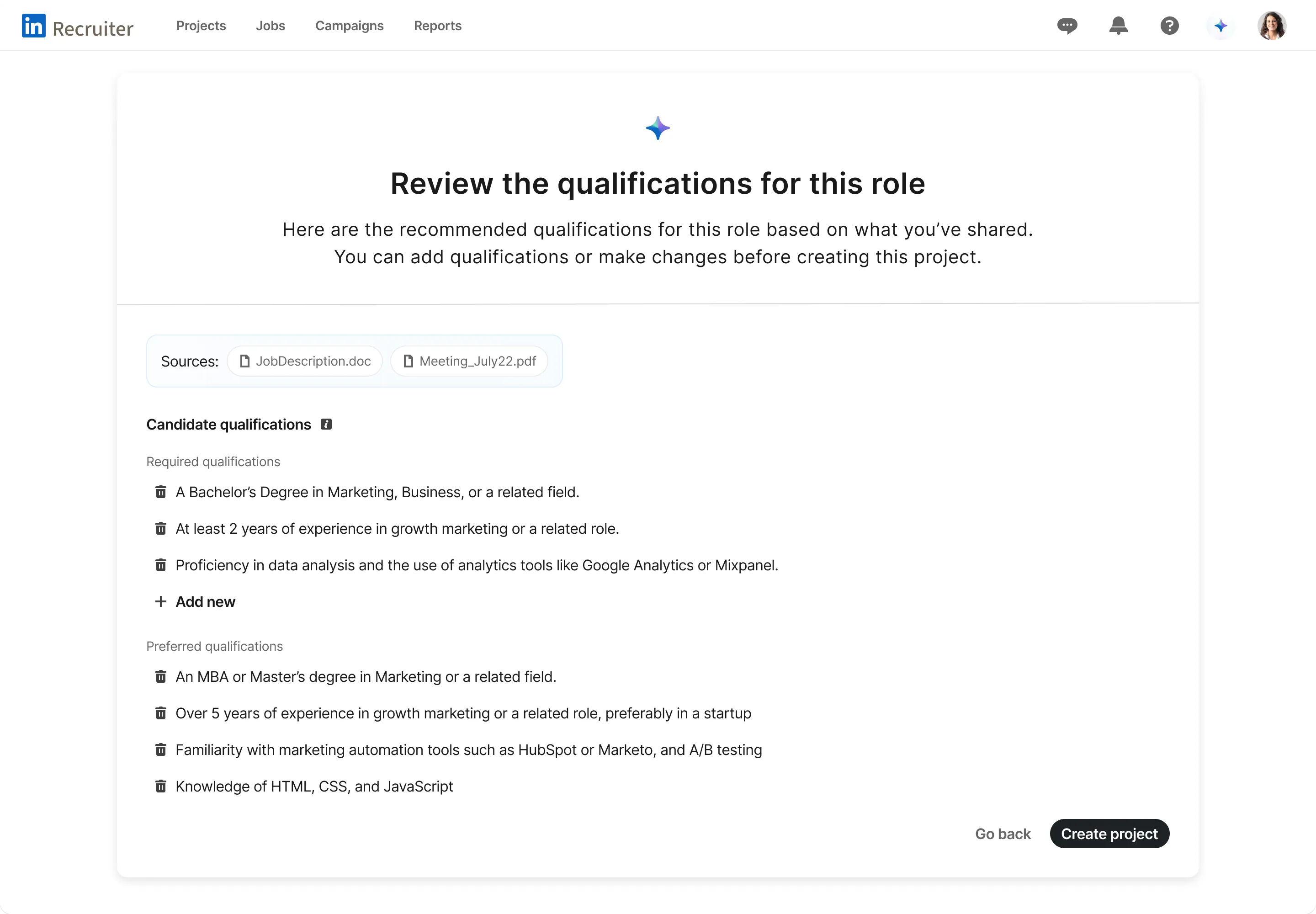
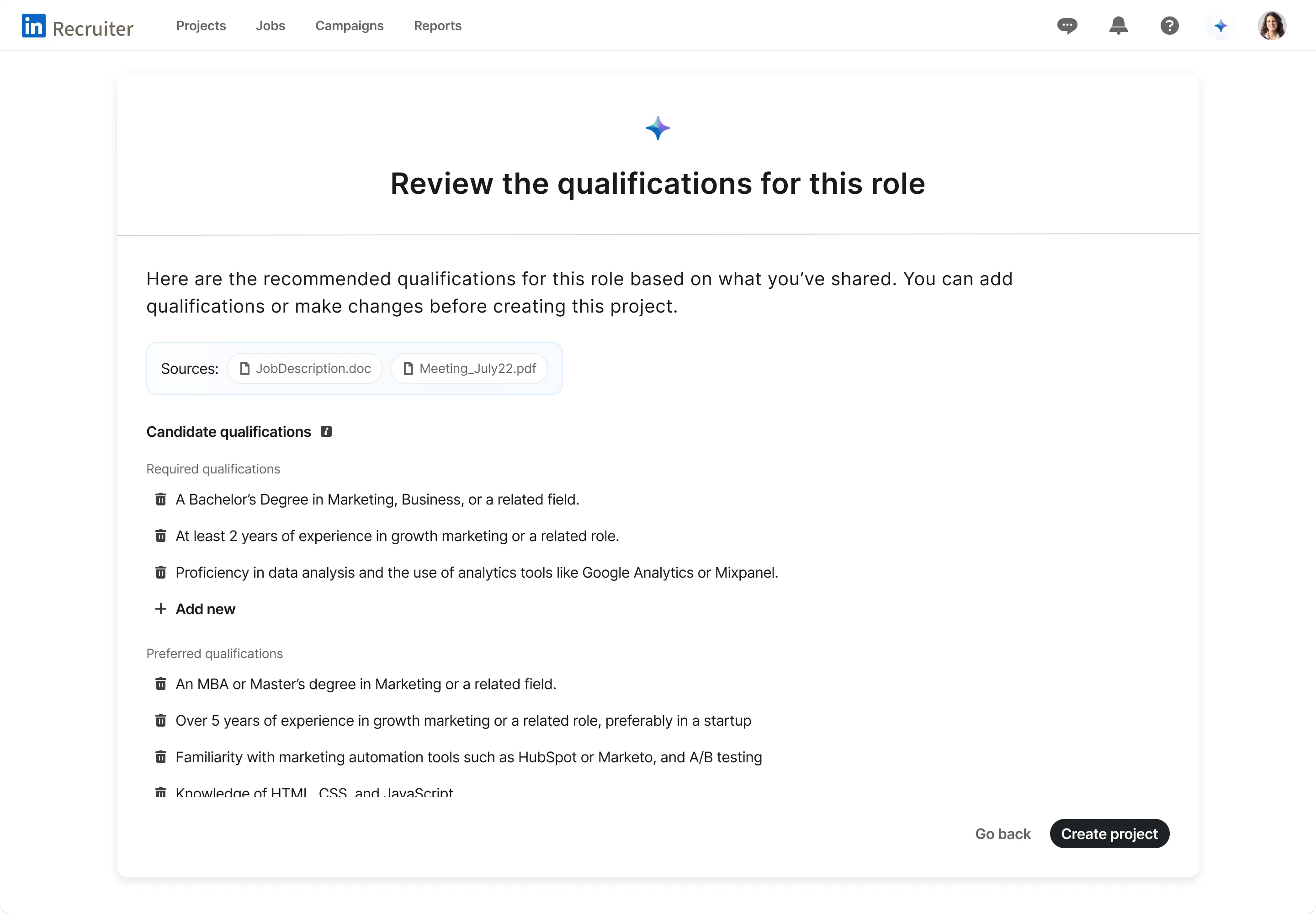
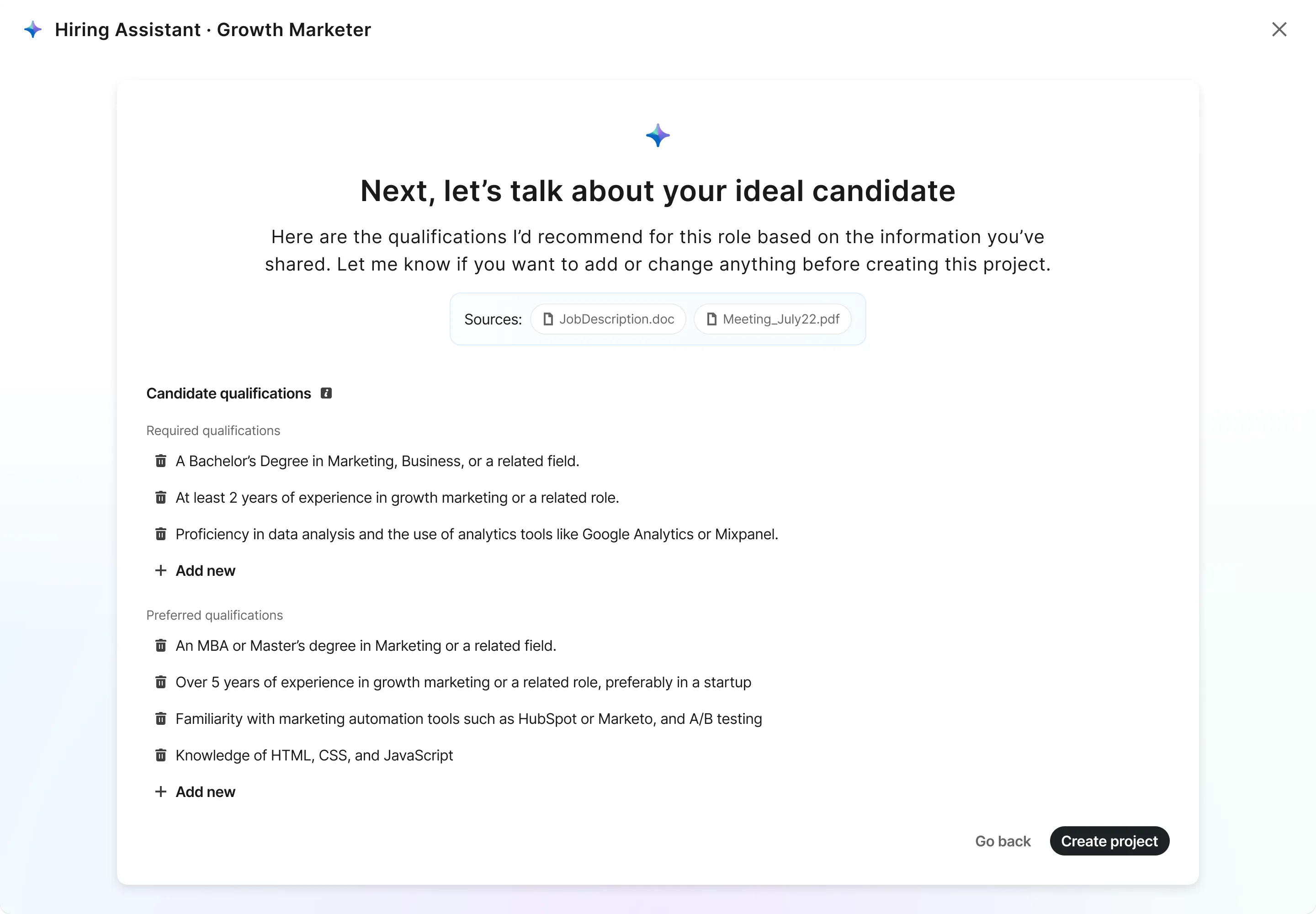
These explorations resulted in what became a sort of pseudo-conversation between Hiring Assistant and the user — one where Hiring Assistant spoke in the header and the user responded through inputs, CTAs, and the canvas at large. A few things in particular worked here.
- The full-screen approach allowed us to lean fully into Hiring Assistant as a new paradigm and tier of experience, rather than something that had fit into the standard Recruiter system.
- This established a scalable architectural framework for how users would engage with Hiring Assistant before the addition of a chat UI.
- The visual aspects of Hiring Assistant’s design directly reinforced this architecture for response and engagement.
Interaction as a pseudo-conversation
This pseudo-conversation became a repeatable framework that helped anchor Hiring Assistant’s design and mental model throughout its early days. And it scaled effectively across the full intake flow — as well as the interaction patterns that emerged in the lead-up to GA.
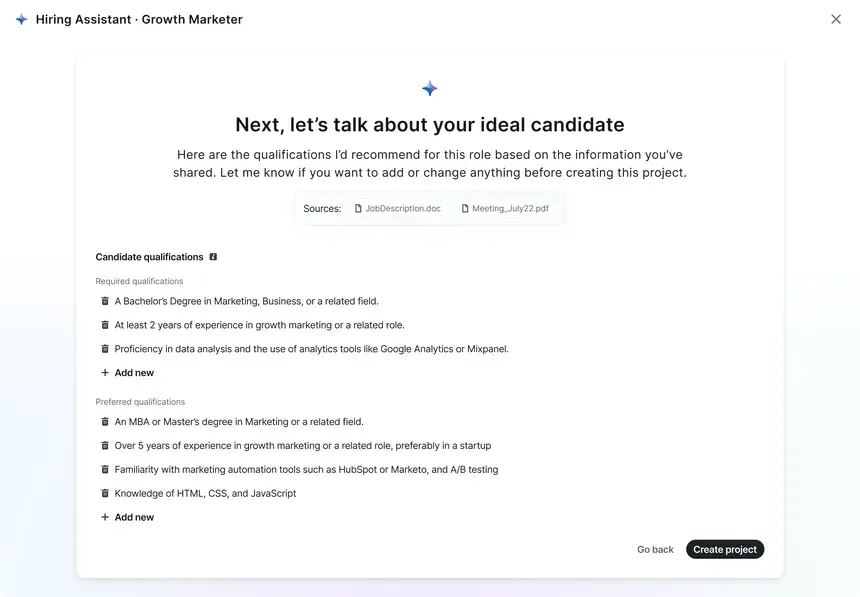
Hiring Assistant’s voice
We leveraged the header on each page as a single, predictable place for the agent’s voice.
The user’s response
The canvas inputs and CTAs acted as affordances for responding to and working with the agent throughout intake.
Gradients that reinforced identity
When in a full-screen experience, subtle gradients on the canvas reinforced the agent’s role and identity within the interaction.
Identity at scale
As the product grew post-charter, so did this pseudo-conversational pattern. The full-screen intake experience persisted for projects, but Hiring Assistant also began appearing more contextually in other corners of the Recruiter product — in notifications, dashboards, contextual callouts and highlights.
The framework evolved from a screen-based pattern into a system with a sharper point-of-view model:
- Full-screen surfaces: Hiring Assistant speaks in the first person, in the header.
- Shared Recruiter surfaces: the UI refers to Hiring Assistant in system language, but where the agent speaks for itself — its own cards, notifications, and callouts — it stays in the first person.
The principles remained the same, just with more nuance. First person is the agent’s voice, and it appears only when the agent is actually talking — and within contained, contextual moments.
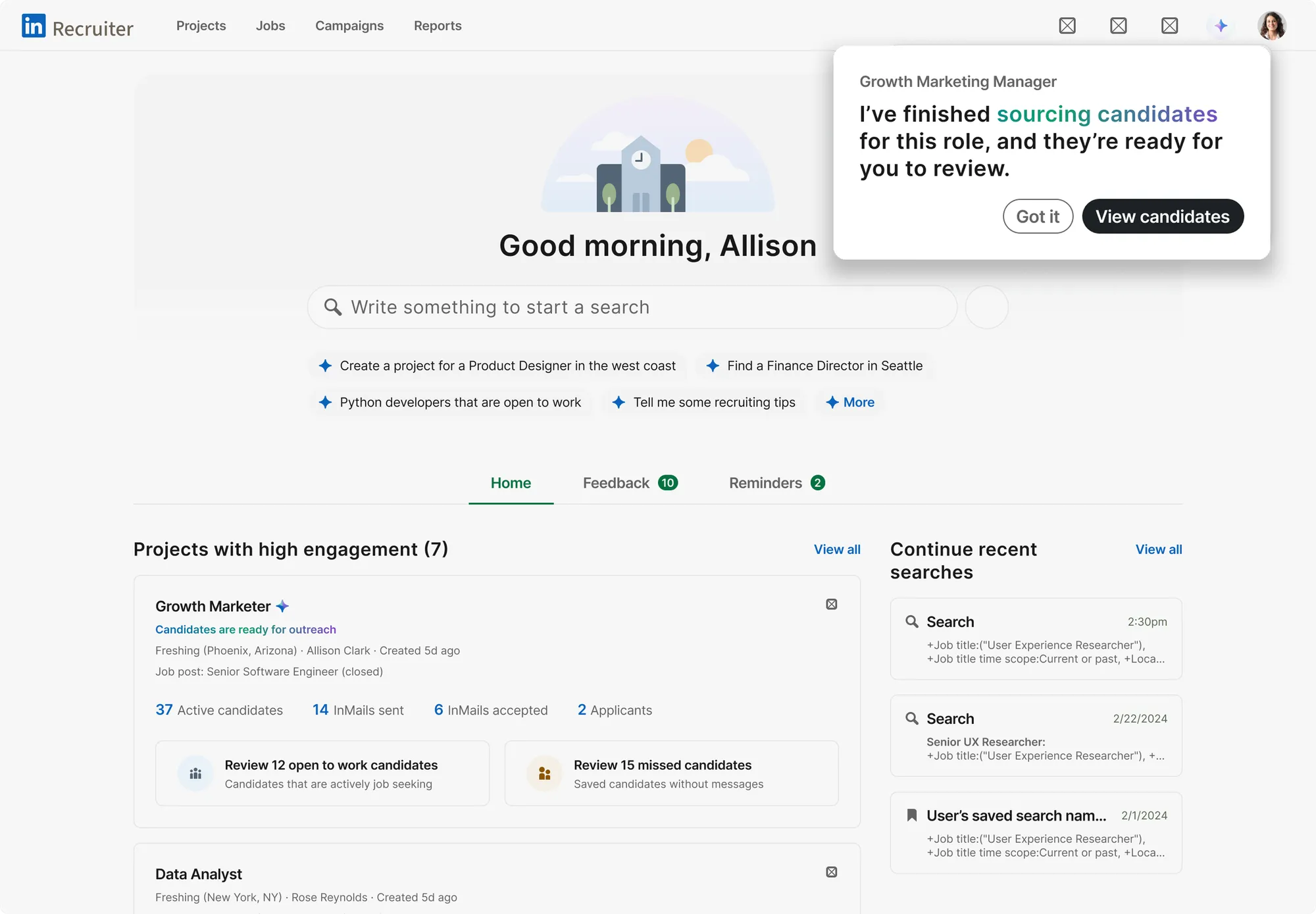
Expanding the charter dashboard
One of the main focuses post-charter was bringing Hiring Assistant’s input to more surfaces outside of the intake and setup flows. At the same, our product teams also wanted to explore an expanded dashboard focused on ongoing tasks and Hiring Assistant collaboration.
This resulted in adding more cards + task types of the dashboard, leaning even further into Hiring Assistant’s own voice and direct communication with the user. Post-chart, the dashboard evolved into one of the agent’s dedicated surfaces.
Hiring Assistant notifications
The expanded dashboard work also coincided with efforts to create a clear distinction between standard Recruiter notifications and Hiring Assistant updates — something that was a clear fast-follow from UXR and early charter insights.
We repurposed the task cards from the dashboard into a new notification component that could appear outside of Hiring Assistant flows, anchored to the dashboard icon in the global nav. The principles stayed the same though: Hiring Assistant’s identity and voice could show up in contained, discrete moments across Recruiter.
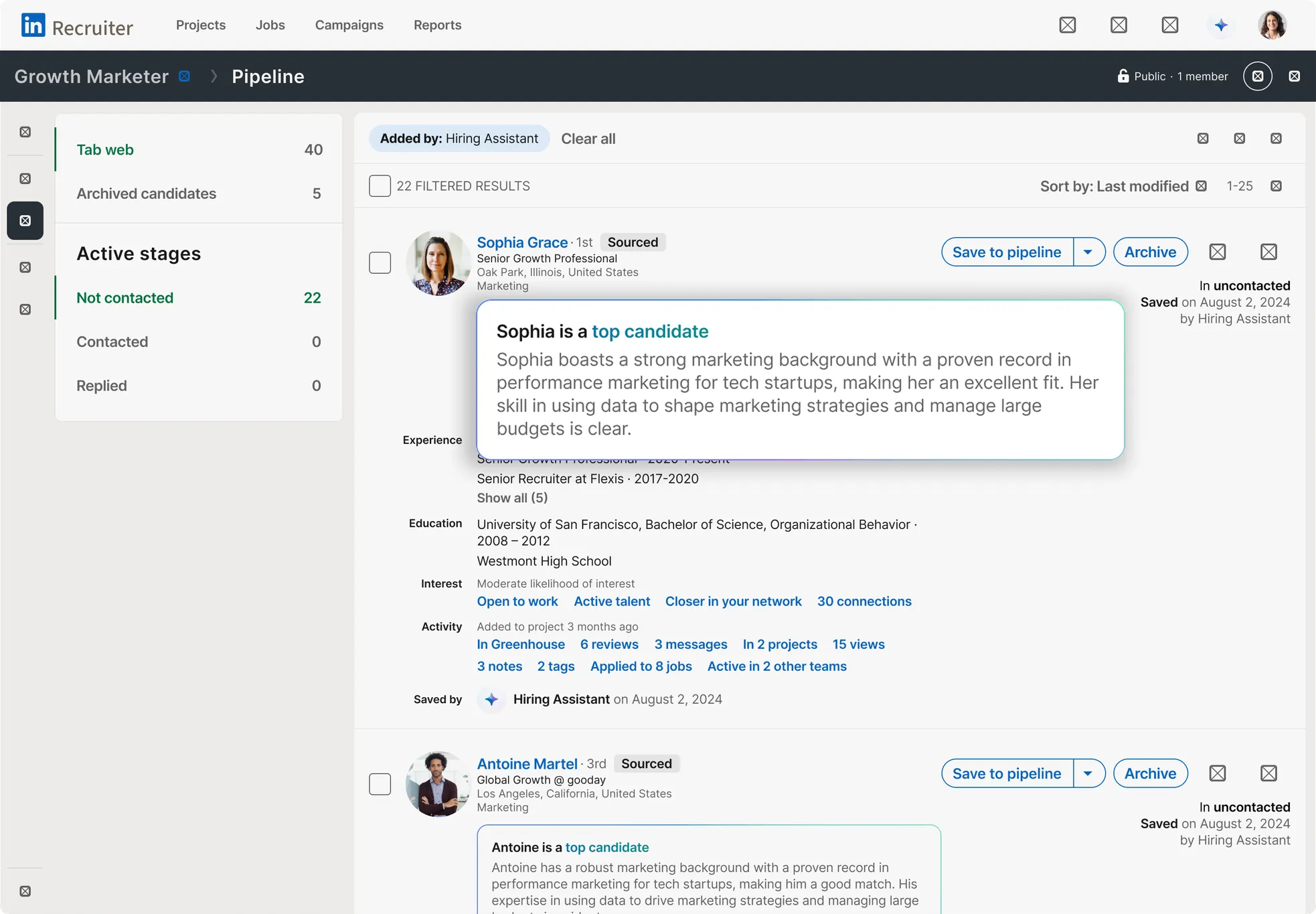
Contextual insights and content cards
Whereas the dashboard and notifications leveraged Hiring Assistant’s full identity and personification, we began paring some of that back for contextual moments within more complex hiring workflows.
For example, during candidate review, insights from Hiring Assistant leverage visual identifiers but rely on system-level content vs. first-person language from the agent. This would eventually evolve into the framework for how Hiring Assistant’s identity shows up in mixed surfaces and workflows.
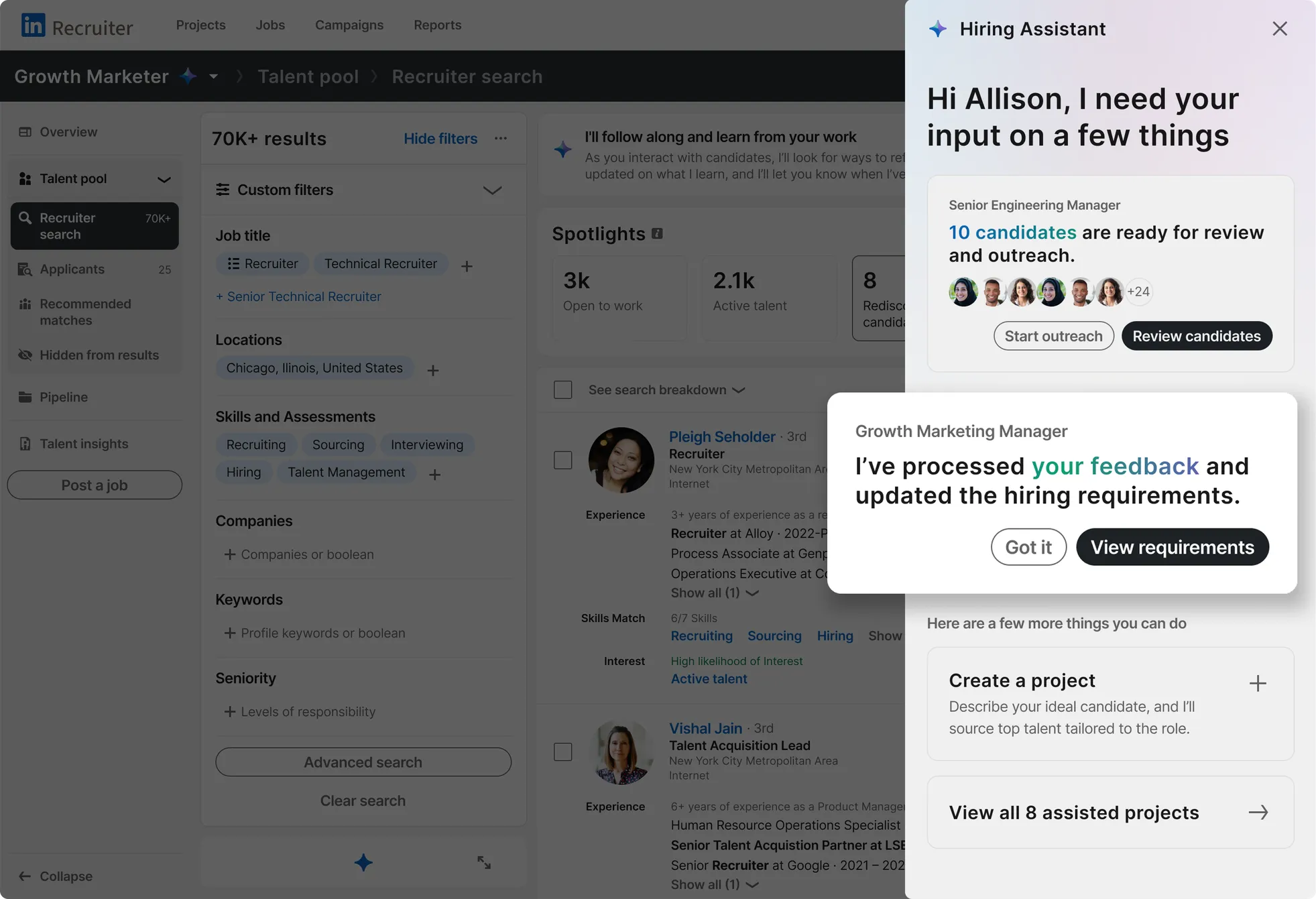
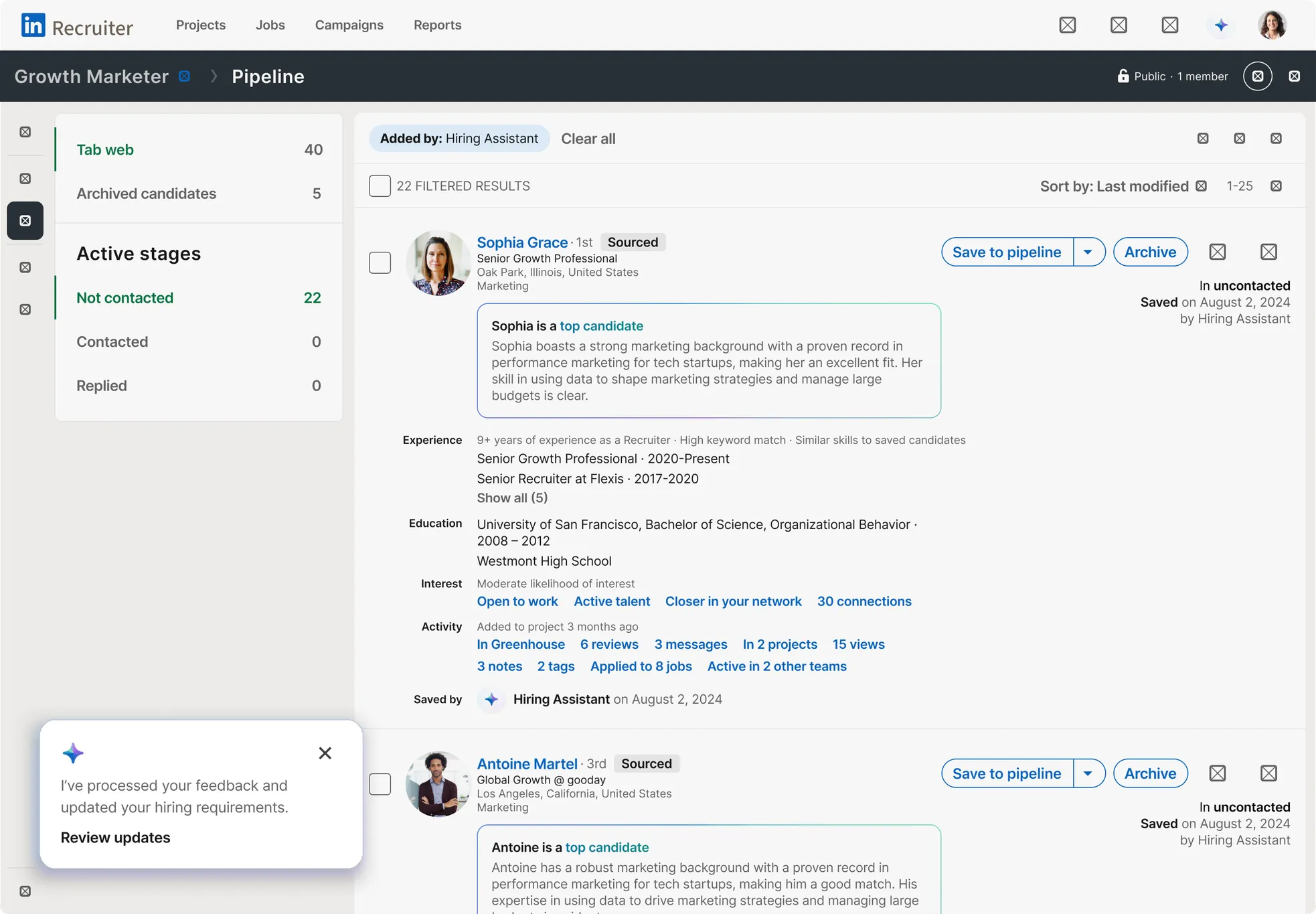
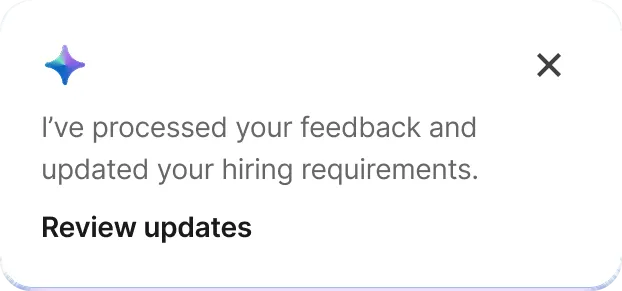
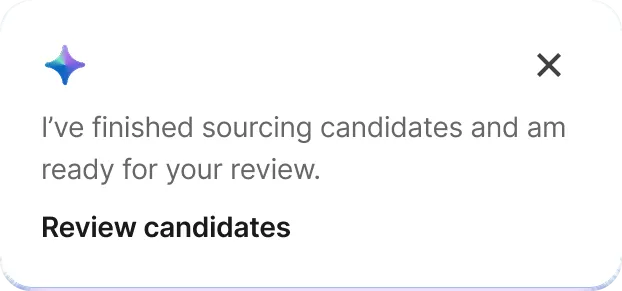
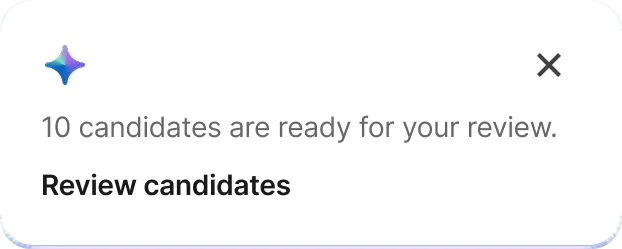
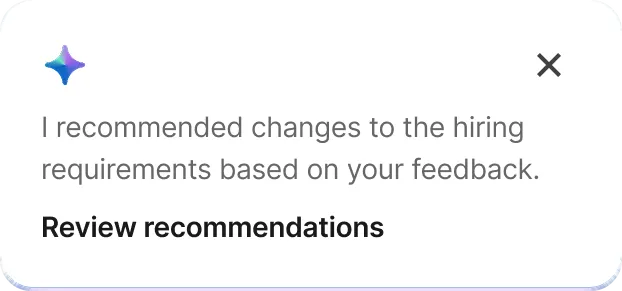
Toasts and ephemeral notifications
However, we still leveraged Hiring Assistant’s full voice and personification for toasts acknowledging specific actions taken within a workflow — like archiving a candidate or sharing positive feedback. These acknowledgments helped keep Hiring Assistant present without convoluting whose voice was present in surfaces with multiple subjects: candidates, the user, Hiring Assistant, and any number of collaborators on a project.
Conversational rudiments
This pattern for ephemeral acknowledgements expanded over time into the building blocks of what would become the framework for Hiring Assistant’s eventual conversational modality. Looking back, it’s fascinating seeing just how strong the interest was in conversation even before the frameworks were fully in place to support it.
The conversational pivot
In spring 2025, conversational capacity became viable for Hiring Assistant, and the product direction moved with it. This meant consolidating everything we’d built previously across intake, setup, and contextual experiences into a dedicated chat modality. It was the biggest test yet of whether these principles, built for a non-conversational UI, would hold up in actual conversation with the agent.
I worked with a cohort of a few other designers to build, test, and lock in product support for this shift — with my work specifically looking at how we carried Hiring Assistant’s identity forward. In practice, this involved adapting the existing personification and POV frameworks into rules for when and how Hiring Assistant talks to users. How it structures responses, how it surfaces suggestions, how it owns and reports back on async work, and how those patterns are encoded into prompting for the agent itself.
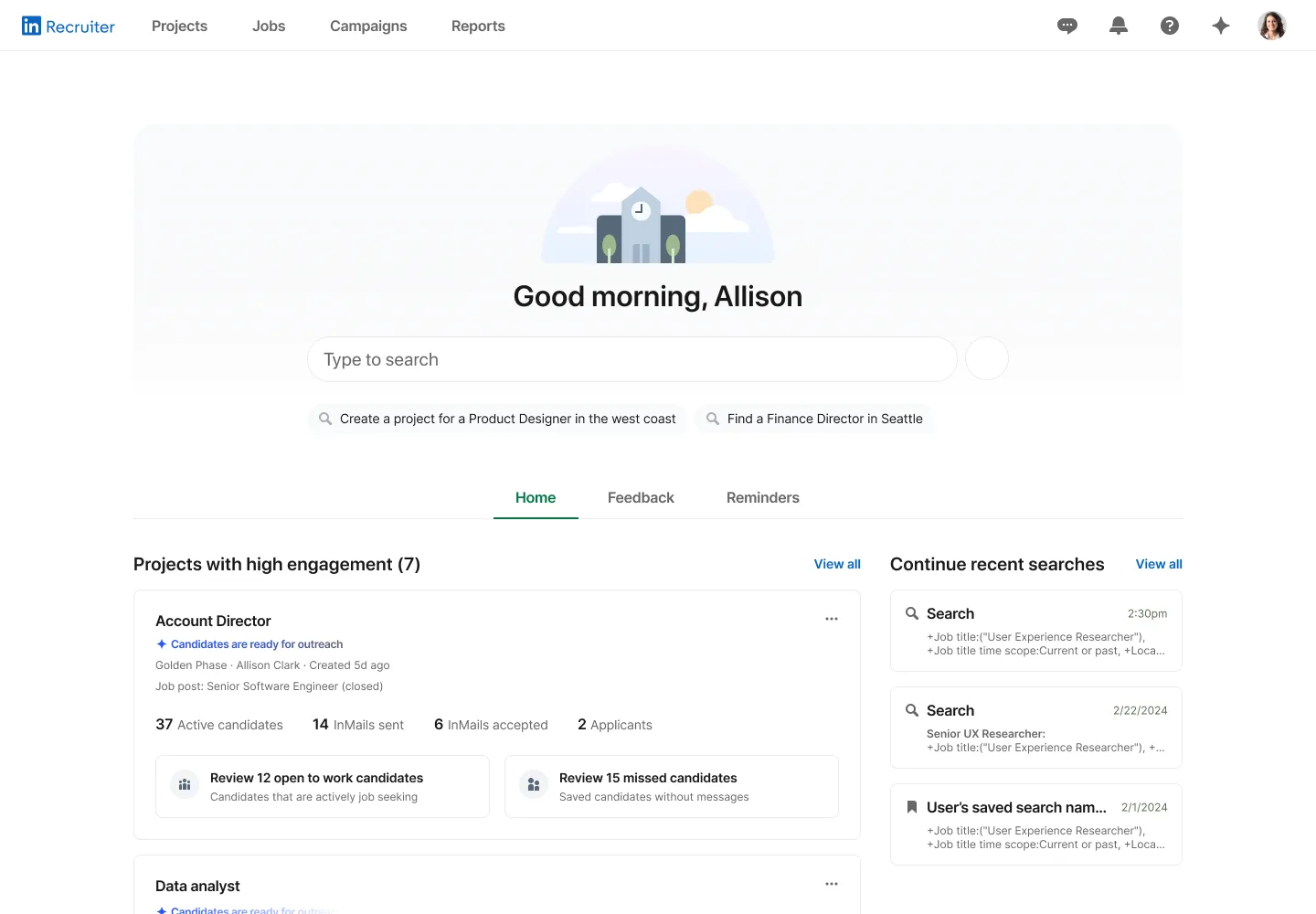
The pseudo-conversation we’d resolved the year prior mapped almost exactly onto this new chat affordance. Chat took over from headers as the home for Hiring Assistant’s first-person voice, while the surrounding UI and canvas carried traditional product content. By Talent Connect 2025, the conversational pivot resolved years of accumulated edge cases — and it allowed Hiring Assistant to land as a truly agentic layer woven throughout Recruiter.


How the architecture evolved
Three releases moved the same set of layers around. What changed was where each one sat and how much of Hiring Assistant’s identity it carried.
That last move was the most significant shift in the framework. First-person voice became reserved for in-chat content, and third-person attribution handled nearly every surface outside the chat window. By GA, users understood the product well enough that constant self-reference had diminishing returns — the point-of-view rule written into the 2024 guidelines, applied in practice and validated by a product pivot a year later.

How we validated this work
UXR and survey research ran continuously across this project, scaling with the product’s scope and maturity. Pre-charter, prospective sentiment research on the hiring industry and AI workflows informed early decisions around identity, architecture, and partnered workflows. Usability testing and hands-on walkthroughs with internal hiring teams ran in parallel and created a strong cycle of feedback.
Post-charter through GA, these tracks grew into a traditional enterprise UXR program — leaning on charter customers for quantitative and qualitative feedback alongside broader studies. Product marketing continued running surveys and relaying performance across CSAT and success signals. And a few themes persisted across the phases of development.
Identity and voice as product architecture
- Higher personification had a material impact on trust and perceived value — specifically Hiring Assistant’s ability to report on its plans and work.
- Clear, contained identity signals were a powerful way to set context for Hiring Assistant's swimlane, especially given the mix of identities present on any given Recruiter surface.
- Nuance mattered more as Hiring Assistant’s presence became more contextual. Identity signals needed to match the agent’s prominence within a flow.
Trust ran on expectations, context, and clarity
- Users needed clear expectations around scope, process, and outcomes. Having Hiring Assistant partner with users on these items was key in driving adoption.
- Likewise, having Hiring Assistant report on its work in first-person was fundamental in reinforcing the agent’s perceived value.
- As Hiring Assistant matured — and as users became more comfortable with the product — expectations around input, planning, and reporting changed. Principles around identity and interaction had to adapt to match evolving functional needs.
Impact + results
Hiring Assistant went from a managed charter cohort in 2024 to global GA in 2025, and it’s continued to accelerate and grow through 2026. And it’s landed by both financial performance and industry sentiment. The agentic Talent Solutions products it anchors crossed a $450M annualized revenue run-rate, and the product itself was received as a true partner for the hiring industry.
- ~36% weekly customer growth after launch — “outpacing every product LinkedIn’s launched,” per chief business officer Mark Lobosco.
- 21 charter customers to global GA — from a managed cohort in 2024 to general availability in 2025.
- 20+ designers leveraging and building on the identity framework — plus product, design leadership, and adjacent agent teams.
The industry read Hiring Assistant as a partner rather than a feature. Aurecon’s talent lead described it in exactly those terms, and Josh Bersin — the most closely watched HR-tech analyst, and the first major voice to weigh in — called it the first highly-integrated agent he’d seen at launch, then named it among the leading AI-powered talent acquisition products a year later. Satya Nadella cited the agentic Talent Solutions run-rate directly on Microsoft’s FY26 Q3 earnings call, placing a LinkedIn product inside Microsoft’s enterprise AI story.
What ties the results together is how the product felt at every stage of its development: agentic, with or without a chat window. The identity framework is what carried that through. It supported design work across my team and became a foundational part of how LinkedIn builds agents across its enterprise products.
Learnings
The clearest learning is that early foundations scale. The early identity decisions held through 2 years of development, a major shift in interaction model, and global GA — all because they were set and aligned on at a system altitude.
The one that changed how I work, though, is about how directions get set. The header stall didn’t break because someone found the perfect answer — it broke when a concrete direction was on the table, with the reasoning to defend it. Owning that track meant being the one who saw the pieces align first, and the one who brought the team in on the resolution as an opportunity.
And lastly, products built on emerging tech are in flux by their very nature. Work goes through cycles, “locked” decisions get reworked, and pivots can change the entire direction of a product. But that’s why frameworks and principles — held at the right altitude — are so valuable. When finer details are shifting, having a shared, guiding set of decisions helps ground everything in an added layer of trust.